Zero Hedge

"Low Hire, No Fire": Jobless Claims Unexpectedly Plunge To Record Low

"Low Hire, No Fire": Jobless Claims Unexpectedly Plunge To Record Low

We have gone from a "low hire, low fire" economy to "AI chatbot hire, no fire." We joke, but really there is no other way to explain what is going on here: this morning the Dept of Labor reported that in the week ended April 25, jobless claims fell 26k to 189k (from an upward revised 215k), compared with median est. 212k. And... are you sitting down... this was the lowest weekly jobless print on record.

With the est. range at 205k-228k, today's print was not only far below the lowest estimate, but a 6 sigma miss to estimates.

While one can normally blame this on seasonal adjustments, the unadjusted number also plunged to just 179K in the last week.

Continuing claims also fell 23k to 1.785m in the week ending April 18. This was the lowest since early 2024.

Those wondering what was behind the unprecedented drop in claims, the answer appears to be a crash in New York State initial claims.

Tyler Durden Thu, 04/30/2026 - 09:28

Heavily Shorted Hertz Soars On Uber Robotaxi Deal

Heavily Shorted Hertz Soars On Uber Robotaxi Deal

Heavily shorted shares of rental-car company Hertz are soaring in premarket trading after the company announced a partnership with Uber Technologies to scale both autonomous robotaxi and driver-led rideshare operations.

Hertz’s Oro Mobility unit will be used as a fleet-management system for Uber’s next-generation mobility network of autonomous robotaxis. This means Oro will support the critical operating layer: charging, maintenance, repairs, cleaning, depot staffing, and vehicle logistics.

"Through its partnerships with Uber, Oro will deliver scalable operational and maintenance services across both autonomous and driver-led operations in key U.S. markets, reflecting the breadth of the companies' collaboration across multiple mobility models," Hertz wrote in a press release.

Oro will support Uber’s autonomous robotaxi program using Lucid vehicles equipped with Nuro AV technology. The new service is expected to launch in the San Francisco Bay Area later this year, with possible expansion next year.

What the Hertz-Uber partnership entails:

Autonomous Robotaxi Fleet Management

Oro will support Uber's autonomous robotaxi program of Lucid vehicles equipped with Nuro AV technology, providing day-to-day vehicle asset management, including charging, maintenance, repairs, cleaning, and depot staffing. Services are expected to launch in the San Francisco Bay Area later this year, as Hertz and Uber explore expansion opportunities in 2027.

Driver-Led Fleet Management

Oro has also partnered with Uber to offer strategic fleet services on the Uber platform, utilizing a fleet of high-quality, well‑maintained vehicles operated by Oro‑employed drivers. The model better enables Uber to meet increasing rider demand with a seamless customer experience, while demonstrating Hertz's ability to deliver turnkey fleet solutions at scale. Following a successful pilot in Atlanta last year, Oro is now also active on the Uber platform in Los Angeles and San Francisco, with Northern New Jersey expected to launch this spring.

"This partnership with Uber establishes Oro as an integrated solution that connects demand with scalable fleet management services. Through this work, we're deepening our capabilities across diverse mobility use cases, and positioning Hertz to play a significant role as the industry evolves," Hertz CEO Gil West wrote in a press release. 

Andrew Macdonald, President and COO of Uber, stated, "Partnering with Hertz's Oro Mobility will help us continue to bring the best autonomous technology onto the Uber platform and accelerate the transition to a hybrid network in which both driver-led and autonomous rideshare operations can scale and serve communities reliably and efficiently." 

The news sent Hertz shares flying in premarket trading, up more than 17%.

Bloomberg data shows Hertz shares are 49% short, equivalent to about 59 million shares. Days to cover stand at around 4.2 days.

Is the squeeze on?

Tyler Durden Thu, 04/30/2026 - 09:20

Core PCE Rises Most In 3 Years; Savings Rate Tumbles As Spending Far Outpaces Income

Core PCE Rises Most In 3 Years; Savings Rate Tumbles As Spending Far Outpaces Income

The Fed's favorite inflation indicator - Core PCE - rose 0.3% MoM in January (as expected), a dip from the 0.4% sequential increase in February, with YoY rising by 3.2% (also as expected), slightly higher than the 3.0% in Feb. That is the highest annual increase in Core PCE since Nov 2023. 

The headline PCE jumped notably more, as expected since it includes non-core items like energy and food, rising 0.7% MoM (as expected) driving prices up 3.5% YoY, also as expected, from 2.8% and the highest since May 2023.

Taking a closer look at the headline print shows a surge in non-durable goods, largely the result of soaring gasoline prices.

On the other hand, core PCE was far more muted, with the monthly increase actually the lowest in three months, even as the annual increase keeps mounting.

Finally, supercore PCE was also muted, indicating that the energy price spillover into the broader economy is taking place but not as fast as some feared.

For those worried about the impact of crude oil's recent surge (since the start of the Iran war), it appears - somehow - that PCE's Energy component has already front-run a lot of the move...

Higher prices were met with higher incomes and higher spending (rising in line with one another for a change): personal income rose 0.6%, double the expected 0.3% and a surge from the 0.0% printed last month. Spending meanwhile rose 0.9%, as expected, and also higher from last month's 0.6%.

Ominously, spending growth continues to outpace income growth

And since spending rose more than income once again (as wages are not keeping up with income), the savings rate just tikced down to a fresh 4 years low.

And with rate-cut expectations in free fall - especially after yesterday's hawkish Fed - this latest data will do nothing to support a dovish take going forward (unless oil crashes the global economy and AI takes over all jobs).


Tyler Durden Thu, 04/30/2026 - 09:04

Those Big, Beautiful Bonds

Those Big, Beautiful Bonds

Authored by Robert Aro via the Mises Institute,

The U.S. Government sells debt on a revolving door basis, yet most people aren’t aware of the mechanism by which this is done. Luckily, ZeroHedge covers the debt auction results, which allows us to articulate one of the structural problems in the Federal Reserve system. As reported last week:

The week’s lone coupon auction priced at 1pm when the Treasury sold $13 BN in 20Y paper, in a solid if not stellar auction.

Deciphering the trader talk in the article, the Treasury took on an additional $13 billion in debt that is repayable in 20 years, paying an annual interest rate of 4.883% (approximately $635 million a year).

A 2.68 bid-to-cover ratio means that for every $1 of debt issued, there were $2.68 in bids, suggesting a healthy market appetite. Only so many entities can lend billions of dollars at a time; here are the three who took the auction:

  • Direct bidders (institutional money like pension funds) took 22.9%;
  • Indirect bidders (foreign central banks) took the brunt at 67.4%;
  • Primary Dealers (JP Morgan, Goldman Sachs, etc.) held just 9.7%.

Since primary dealers are mandated to buy, and since the Fed will buy from them, the free-market price and demand for debt remains a mystery. Therefore, without the Fed’s anti-capitalist intervention, demand would be lower and yields would be higher.

A $13 billion debt still seems incomprehensible, so let’s assume you had $100,000 today and had to keep it in a cash equivalent for the next two decades. What would you choose? If you bought that Treasury, you’ll be earning 4.883% interest each year, and in 2046 you’ll get your principal back in full.

Whether rates go up or down, neither outcome will be pleasant, leaving you, the bondholder, caught between the Unthinkable and the Unimaginable.

The Unthinkable: Should the market demand a higher yield, or should the Fed raise rates, your 4.883% return will no longer be a good deal. If you sell, you’ll take a loss. On a societal level, for each 1% increase in rates, the interest burden on the $39 trillion debt climbs toward an additional $390 billion annually as the debt rolls over. At some point, the interest alone begins to choke the life out of the economy. If there is any consolation, maybe this fights “price inflation,” but even that’s uncertain, and prices could still skyrocket along with rates.

The Unimaginable: U.S. politicians find a way to balance the books and take on less debt… but in reality, history has shown this to be impossible. In all likelihood, the Fed will have to keep rates low and the debt spiral manageable by increasing its bond purchases and the money supply, i.e., inflation in the traditional and honest sense. In this scenario, your 4.883% bond is worth more on paper, but your currency will likely be worth a lot less.

The Fed faces an impossible task. To abstain from intervention is to allow high interest rates to compound on an unrepayable debt. To intervene is to flood the system with debased currency. Either way, the bondholder is the casualty, and the capital structure is the cost.

Feel free to sit with your 4.883% bond and wait for the Fed to make a move. In the end, it almost doesn’t matter whether rates go up or down; you’re simply watching society erode, one basis point at a time. The interest rate is the symptom; the debt mechanism is the disease.

Tyler Durden Thu, 04/30/2026 - 09:00

Russia Says UAE's 'OPECxit' Won't Spark Immediate Price War

Russia Says UAE's 'OPECxit' Won't Spark Immediate Price War

Russian Deputy Prime Minister Alexander Novak, quoted by the Russian news agency Interfax, downplayed fears that the UAE's planned OPEC exit will trigger an immediate oil price war and race to the bottom. 

"In the current situation, what kind of price war can there be when there is a shortage in the market?" Novak said, adding with the Strait of Hormuz remaining all but closed, "a huge amount of oil isn't reaching the market today, and demand is significantly higher than supply."

Novak said Russia and Saudi Arabia have yet to discuss the UAE's decision to leave OPEC, effective Friday. He reiterated that Moscow has no plans to leave the OPEC+ alliance.

Novak's core message is that the global market is supply-starved as the U.S.-Iran war chokes energy flows through the Hormuz waterway. Large volumes of crude remain physically constrained, keeping global demand above available supply and limiting Abu Dhabi's ability to flood the market in the near term.

However, once Washington and Tehran strike a peace deal and reopen the Hormuz chokepoint, that's where Abu Dhabi will be able to ramp up production outside OPEC's quota system. That would inject a fresh wave of supply worldwide, weaken the oil cartel's ability to set a proper price floor, and raise downside risk for Brent once Gulf flows normalize.

JPMorgan analyst Ian Mitchell told clients earlier this week: 

The UAE has announced it will leave OPEC. Flat crude prices will remain driven by the situation in the Strait of Hormuz, but this development will likely mean medium-term prices are lower than they would have been otherwise, though there are many moving parts."

Mitchell added:

"Better too early than too late when it comes to taking profits on EU oil equity longs."

We agree with Mitchell's assessment:

UBS analyst Henri Patricot told clients a very similar message:

"Limited impact near-term; downside risk for oil prices medium-term." 

Overnight Brent price action commentary from UBS analyst Dominic Ellis:

Brent was briefly over $126/b this morning, and has settled above $124/b, on media reports that President Donald Trump will be briefed Thursday on new military options to pressure Iran to re-open the Strait of Hormuz.

This follows a move up on Wednesday as Trump publicly acknowledged the likelihood of an extended blockade of the Strait. In its World Economic Outlook a couple weeks ago, the IMF cut its base case for global growth for FY2026 to 3.1% from 3.4%, but this was predicated on a rapid resolution of the Iran situation and a quick resumption of energy flows. I'd argue we're moving towards more bearish scenarios which the market has yet to price in.

Readers can read the full note here: "OPECxit: JPM, UBS React To UAE's Shock Departure From Oil Cartel."

Professional subscribers can read JPM and UBS notes here at our new Marketdesk.ai portal.

Tyler Durden Thu, 04/30/2026 - 08:40

ECB Holds Rates At 2%, As Expected, With Stagflation Looming

ECB Holds Rates At 2%, As Expected, With Stagflation Looming

The European Central Bank kept interest rates unchanged, as expected, with officials signaling they need more time to assess the extent of the Iran war’s jolt to the economy. The deposit rate was left at 2%, where it’s been since June 2025 and in line with the predictions of all analysts in a Bloomberg survey. The ECB offered no guidance on future decisions, reiterating it will act one meeting at a time based on information as it arrives.

In the statement, the committee cited the usual stagflationary cocktail as cause for concern, namely upside risks to inflation and the downside risks to growth have intensified. As usual, they emphasize the data-dependent and meeting-by-meeting approach and added that their assessment of the inflation outlook and its risks, will be informed by incoming economic and financial data, as well as the dynamics of underlying inflation and the strength of monetary policy transmission.

“The upside risks to inflation and the downside risks to growth have intensified,” the Governing Council said on Thursday in a statement.  The Governing Council remains well positioned to navigate the current uncertainty.”

Commenting on the decision, DB's Chief European Economist Mark Wall said that "the accompanying statement flags an intensification of risks. These are symmetric: upside risks to inflation, downside risks to growth. There remains a sense of calm confidence, with references to the resilience of the economy in recent quarters and longer-term inflation expectations remaining well-anchored. But there is also a sense of rising concern the longer the conflict in the Middle East continues. Overall, this is a statement that does not pre-commit the ECB to hiking in June. But it does not stop the ECB from hiking in June either."

Here are the statement highlights:

RATES:

  • ECB Governing Council holds three key interest rates unchanged
  • Deposit facility rate held at 2.00% (exp. 2.00%)
  • Main refinancing operations rate held at 2.15% (exp. 2.15%)
  • Marginal lending facility rate held at 2.40% (exp. 2.40%)

GUIDANCE:

  • ECB not pre-committing to a particular rate path
  • Governing Council to follow data-dependent, meeting-by-meeting approach to policy stance
  • Interest rate decisions to be based on inflation outlook and risks, incoming economic and financial data, underlying inflation dynamics, and strength of monetary policy transmission
  • Governing Council stands ready to adjust all instruments within its mandate to ensure inflation stabilises at 2% in the medium term
  • Transmission Protection Instrument available to counter unwarranted, disorderly market dynamics that pose a serious threat to monetary policy transmission

INFLATION:

  • Upside risks to inflation have intensified
  • Euro area entered current period with inflation at around the 2% target
  • Shorter-horizon inflation expectations have moved up significantly
  • Longer-term inflation expectations remain well anchored
  • War in the Middle East has led to a sharp increase in energy prices, pushing up inflation
  • Longer the war continues and energy prices remain high, the stronger the likely impact on broader inflation

ECONOMY:

  • Downside risks to growth have intensified
  • War in the Middle East weighing on economic sentiment
  • Euro area economy has shown resilience over recent quarters
  • Implications of war for medium-term inflation and activity will depend on intensity and duration of energy price shock and scale of indirect and second- round effects

While policymakers have stressed since the conflict broke out that they’ll act decisively if inflation shows signs of spiraling, data available so far haven’t convinced them. The ECB isn’t alone in holding fire: The Federal Reserve sat tight on Wednesday and the Bank of England decided against a move earlier on Thursday.

The ECB is also mindful of the blow to output, with data published shortly before its rate announcement showing first-quarter gross domestic product grew by a less-than-expected 0.1% in the euro zone — feeding stagflation fears.

Markets reckon officials will focus on the upswing in prices, which jumped by 3% in April — the quickest since the autumn of 2023 — due to the ramp-up in energy costs. Traders are fully pricing three quarter-point increases in borrowing costs by year-end.

President Christine Lagarde will offer her thoughts at a news conference at 2:45 p.m. Watch it live below:

Tyler Durden Thu, 04/30/2026 - 08:29

Futures Jump After Overnight Rollercoaster Session As Oil Unexpectedly Tumbles, Yen Soars

Futures Jump After Overnight Rollercoaster Session As Oil Unexpectedly Tumbles, Yen Soars

Futures erase an overnight slide, and have resumed their ascent trading near all time highs, despite a hawkish Fed statement but stronger Mag7 earnings. The hawkish Fed followed by a less hawkish press conference, plus the news that Powell is staying on seemingly removing a cut, actually have bond yields lower pre-mkt by 2-4bp as the Dollar weakens on what appears to be BOJ intervention which has sent the USDJPY plunging most since 2022. As of 8:00am ET, S&P futures are up 0.4%, erasing a 0.5% drop earlier in the session; Nasdaq futures gain 0.6%: in premarket trading Alphabet is the big gainer from the major tech companies that reported, with Amazon rising too but Meta and Microsoft falling (META -9% AMZN +2.3%, GOOG +6%, and MSFT -1.8%). Semis continue to trade higher as well as Discretionary, Industrials and Materials while Financials, Healthcare and Staples lower as Cyclicals lead Defensives. Energy names are mostly lower after striking rollercoaster in the price of oil. In commodities, energy is weaker, metals are higher led by precious, and Ags are mostly higher. Today’s US economic data calendar slate includes jobless claims, personal income and spending, 1Q employment cost index and first estimate of Q1 GDP (8:30am), April MNI Chicago PMI (9:45am, several minutes earlier for subscribers) and March Leading Index (10am)

In premarket trading, Mag 7 are mixed (NVDA +0.8%, AAPL +0.4%, TSLA +0.08%)

  • Alphabet (GOOGL) jumps 7% after reporting high demand for its cloud and artificial intelligence offerings, giving investors confidence that its unprecedented investments in AI infrastructure will pay off.
  • Amazon.com (AMZN) climbs 3% after the e-commerce and cloud-computing company reported first-quarter results that beat expectations on key metrics. Analysts are broadly positive on the report, saying that the acceleration of Amazon Web Services is underway.
  • Meta Platforms (META) falls 9% after the Facebook parent gave a forecast for capital expenditures that was higher than expected, a sign that investors remain skeptical about AI-related spending in some instances.
  • Microsoft (MSFT) slips about 2% after the software company reported third-quarter results. Some analysts said the pace of growth in its Azure cloud-computing business may have underwhelmed.
  • Blue Owl Capital (OWL) gains 4% as fee-related earnings and assets increased as the alternative investment firm leaned on other parts of its business amid souring sentiment toward private credit.
  • Carvana (CVNA) rises 11% after the company reported revenue for the first quarter that beat the average analyst estimate as used-car volumes hit a record.
  • Caterpillar (CAT) climbs 5% after posting first-quarter earnings that beat Wall Street expectations as surging electricity demand from artificial intelligence data centers boosted sales of the company’s power-generation equipment.
  • Chipotle Mexican Grill Inc. (CMG) gains 4% after eeking out higher sales last quarter, suggesting the chain is starting to win back diners who previously balked at the rising price of its burritos.
  • Eli Lilly (LLY) rises 7% after raising its full-year sales outlook on the strength of its weight-loss drugs and high hopes for its new obesity pill.
  • Ford (F) falls 4% after warning that an unexpected rise in commodity costs will weigh on earnings.
  • FormFactor (FORM) rises 10% after the semiconductor manufacturing company reported first-quarter results that beat expectations on key metrics, although analysts were especially positive on the company’s gross margins.
  • KLA Corp. (KLAC) falls 4% after analysts note the tepid growth rate at the semiconductor capital equipment company when compared to peers.
  • Merck (MRK) gains 3% after the drugmaker reported sales for the first quarter that topped Wall Street’s expectations.
  • Procept Biorobotics (PRCT) gains 15% after the medical and surgical equipment manufacturer reported revenue for the first quarter that surpassed expectations.
  • Stellantis (STLA) is down 5% after the carmaker posted first-quarter results that included disappointing numbers from North America.
  • Qualcomm (QCOM) jumps 11% after the company posted mixed results, but said that it was “excited” by its entry into data centers, where a “leading hyperscaler custom silicon engagement is on track for initial shipments later this calendar year.”
  • Quanta Services (PWR) gains 6% after the provider of contracting services to electric utility companies reported adjusted earnings per share for the first quarter that beat the average analyst estimate.
  • Royal Caribbean Cruises (RCL) rises 7% after posting first quarter adjusted EPS that topped estimates.
  • Smurfit Westrock (SW) falls 5% after the packaging company reported first-quarter adjusted Ebitda that missed analyst estimates.
  • Wayfair (W) tumbles 8% after the ecommerce firm reported adjusted earnings per share for the first quarter that missed the average analyst estimate.

In other corporate news, Starwood Capital is “temporarily suspending” share repurchases from its Starwood REIT to preserve liquidity while waiting for the commercial real estate market to improve. Stellantis shares fell after analysts pointed to the automaker’s worse-than-expected financial performance in North America. And Pop Mart reported a sharp slowdown in US sales, underscoring its challenges in diversifying beyond the Labubu toy. In other AI news, OpenAI has met a key milestone for securing AI capacity in the US several years ahead of schedule, boosting the startup’s ambitious plans for data center expansion. SoftBank plans to establish and list an AI and robotics company called Roze in the US. And banks that recently signed a $40 billion bridge loan with SoftBank for its investment in OpenAI are said to have attracted more lenders to the deal in syndication.

Market sentiment got a boost as global benchmark Brent crude oil erased an intraday jump of as much as 7.1% to above $126 a barrel. Axios had reported that President Donald Trump was slated to receive a briefing Thursday on new plans for potential military action in Iran, clouding hopes for an imminent peace agreement. It was unclear what prompted the oil reversal, although there has been speculation that the BOJ is intervening in both FX and oil.

From swings in oil prices to a divided Federal Reserve keeping rates on hold and impressive megacap tech earnings, traders are grappling with a barrage of whipsawing headlines. That’s testing a global equity rally that has wiped out war-related losses and pushed US markets to new highs as investors still look for signs of an end to the conflict.

“Equities are caught in between escalating Middle East tensions and strong fundamental earnings data being released,” said Wolf von Rotberg, equity strategist at Bank J Safra Sarasin Ltd. “Oil prices moving toward $150/bbl would likely increasingly impact the consumer in the US, which would also mark a turning point for equity markets. Thus, a deal is required to see a continued move higher over coming months.” 

For stocks, “earnings expectations are behaving like a force of nature, and that is more important than anything else,” writes Bloombing Opinion columnist John Authers. Traders are also looking at the playbook from Ukraine and the tariff turmoil, but “it’s hard to believe they’re not over-confident.”

On balance, the frenzy of earnings after the close had a reassuring message, and a clear winner: Alphabet’s Google was able to point to solid growth at its cloud computing unit, which recorded estimate-beating sales of $20 billion last quarter, justifying its AI spending.

Meta was the loser of the pack, with shares sliding after it boosted full-year capex to as much as $145 billion. Investors are concerned that the investments may not pay off, as Meta’s AI system still trails its peers. “So far, Meta’s stand-alone app hasn’t had the amount of engagement vs. other frontier labs,” said BI analyst Mandeep Singh. Amazon was relatively well received, with revenue from its cloud division up 28%, the fastest growth rate since 2Q 2022. Microsoft slightly underwhelmed with a forecast for a “modest acceleration” in Azure cloud sales in the second half of the calendar year.

Japan’s currency strengthened as much as 1.6% against the dollar to 157.85, its lowest since April 17, after Japan’s top currency official Atsushi Mimura echoed Minister of Finance Satsuki Katayama’s warning earlier Thursday that “the timing for taking bold steps is nearing.”

In politics, the 74-day shutdown of the Department of Homeland Security is nearing an end after House Speaker Mike Johnson united Republicans behind a two-part budget plan to fully fund the department. Members of Trump’s administration are said to have told Anthropic that they don’t agree with the company’s plan to grant access to its Mythos technology to roughly 70 companies and organizations.

European Stocks turned positive, with the Stoxx 600 now up by 0.4% having fallen as much as 0.7% ahead of the European Central Bank’s interest-rate decision today. BNP Paribas fell after the lender reported higher credit provisions than expected. Credit Agricole and Societe Generale also dropped after results.Here are the biggest movers Thursday:

  • Arcadis shares gain as much as 14%, the steepest intraday gain since July 2020, after the Dutch engineering services firm’s first-quarter results met with a positive response from Degroof Petercam analysts
  • Glencore shares gain as much as 2.6% after the trading and mining giant posted strong profits, with 2026 full-year marketing Ebit expected to “comfortably exceed the top end of the range”
  • United Utilities, the water utility company, rises as much as 12% to a record high following an £800m equity raise announcement. Analysts say the raise supports accelerated asset base growth and upgraded return targets
  • Magnum Ice Cream shares rise as much as 13%, the biggest jump since its listing in December last year, after the former Unilever unit reported strong first-quarter volumes
  • Delivery Hero gains as much as 6.6% after the food delivery firm said it’s confident of achieving upper half of its Ebitda guidance range. That comes after 1Q results beat estimates and showed a modest recovery in its core market Asia
  • Puma shares rose as much as 4.1% on Thursday after reporting gross profit margin and sales for the first quarter that beat the average analyst estimate, with analysts saying the results were solid and showed progress
  • BNP Paribas shares dropped as much as 5.3% amid a wider decline for its French peers. The lender reported what analysts say are mixed results with a beat driven by its Corporate Centre unit, while the Arval unit disappointed
  • SocGen shares decline as much as 6.7% on earnings that KBW called lackluster after fixed income revenue missed estimates. Profit beat consensus as equity trading and French retail units jumped from a year earlier
  • Stellantis shares fall as much as 10% after the carmaker posted first-quarter results where key North America numbers disappointed, with analysts seeing a somewhat mixed print
  • Erste Group Bank shares slide as much as 4.6% after the lender reported what a Barclays analyst called a low-quality profit beat helped by one-off gains, with adjusted earnings falling short of expectations
  • Weir Group shares fall as much as 9.9% after the mining equipment provider reported first-quarter orders that analysts said look weak relative to peers
  • Technip Energies shares slump as much as 10%, the most since October 2023, after the French engineering and technology company reported weaker-than-expected earnings for the first quarter and cut its guidance

Asian stocks slumped as Brent crude surged to a four-year high, fueling inflation concerns and dragging currencies lower across the region’s emerging economies. The MSCI Asia Pacific Index slid as much as 1.6%, the most intraday since April 2, before paring some declines. Equity benchmarks in Indonesia, South Korea and the Philippines were among the top losers. All sectors on the regional gauge fell, except energy. Thursday’s losses pared the MSCI Asia gauge’s April gain to under 13%. It was still on course for its best month since November 2022, with a rally in tech names having overshadowed the impact of the US-Iran war on the broader market. Asian tech shares outperformed earlier on Thursday, following indications of continued high spending on AI infrastructure by the likes of Alphabet and Meta Platforms. Samsung Electronics’ chip arm beat expectations with a 48-fold jump in profit. However, those gains faded as the session progressed, suggesting investors likely trimmed positions ahead of the long weekend. Many of the region’s markets will be shut on Friday.

In FX, the yen the standout in currencies on increasing intervention risks, Bloomberg Dollar Spot Index down 0.4%. The pound and UK bonds gained after the Bank of England left interest rates unchanged, with several policymakers saying they might consider future hikes given high energy prices. 

In rates, treasuries rebounded after the surge in oil and a hawkish hold by the Fed drove bonds lower on Wednesday.  US front-end yields are more than 5bp lower on the day, steepening 2s10s and 5s30s spreads by 2bp-3bp. 10-year, lower by about 4bp at session low 4.39%, trails 7bp drop for UK 10-year. US 30-year is back below 4.98% after topping 5% late Wednesday for the first time since July. UK gilts rally after Bank of England held rates steady, meeting expectations.

In commodities, oil prices reversed an earlier spike which took them to a wartime high, after Axios reported that US President Donald Trump will receive a briefing on new military options for action in Iran, signaling the potential for fresh escalation in the Middle East. The two sides showed little sign of breaking their impasse and agreeing to another round of peace talks, with Trump saying his navy’s blockade is working. However, shortly after the European open, oil tumbled with Brent now falling back toward $114.Gold prices higher and back above $4,600/oz.

US economic data calendar slate includes jobless claims, personal income and spending, 1Q employment cost index and first estimate of Q1 GDP (8:30am), April MNI Chicago PMI (9:45am, several minutes earlier for subscribers) and March Leading Index (10am)

Market Snapshot

  • S&P 500 mini +0.4%
  • Nasdaq 100 mini +0.5%
  • Russell 2000 mini +0.2%
  • Stoxx Europe 600 +0.2%
  • DAX +0.2%
  • CAC 40 -0.8%
  • 10-year Treasury yield -3 basis points at 4.4%
  • VIX -0.5 points at 18.31
  • Bloomberg Dollar Index -0.2% at 1199.46
  • euro +0.1% at $1.169
  • WTI crude +0.1% at $107.01/barrel

Top Overnight News

  • Trump will receive a briefing on Thurs about potentially resuming military operations against Iran. Brent pushed to a 4 year high. Axios
  • As Hormuz traffic stalls, the White House pitches a new coalition to get ships moving again. Trump reportedly wants other nations to form an alliance to help jump-start ship traffic. WSJ
  • Japan’s top currency officials rolled out their “final” warning to speculators after the yen slipped to its weakest level since the nation’s last salvo of market interventions in 2024. BBG
  • China’s factory activity held up in April, suggesting limited pressure from surging energy prices due to the conflict in the Middle East. China’s NBS PMIs for Apr were mixed, with manufacturing outperforming (50.3 vs. the Street 50.1) while non-manufacturing fell short (49.4 vs. the Street 49.8), and the RatingDog manufacturing PMI was ahead of plan too at 52.2 (vs. the Street 51). WSJ
  • China has given state-owned refiners the green light to export 500,000 tons of fuels to a handful of regular customers, signaling the country is effectively easing an earlier ban on shipments. BBG
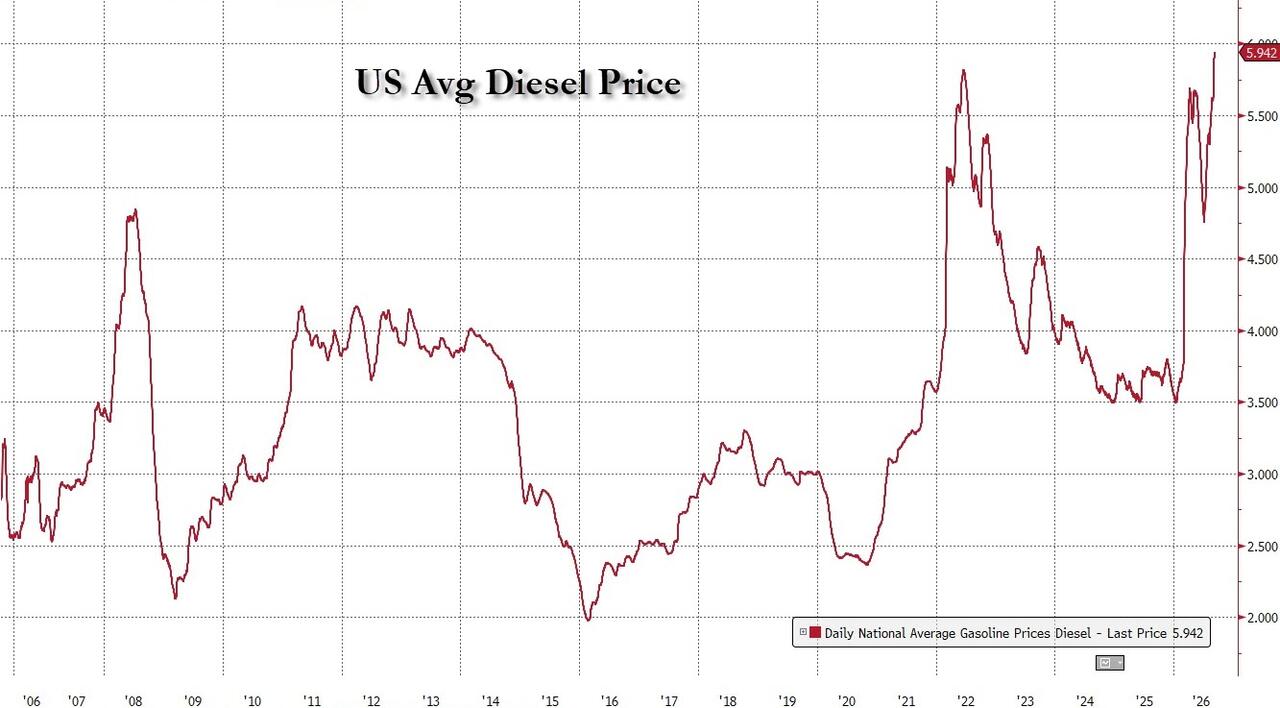
  • California gasoline prices topped $6 a gallon as the global energy crunch from the war reverberates. No other state has ever surpassed that mark. BBG
  • Anthropic faces White House opposition to its plan to expand access to its Mythos AI model, an administration official said. Separately, the company is said to be weighing fresh funding that would value it at more than $900 billion. BBG
  •  The record 74-day shutdown of the DHS is nearing an end after Mike Johnson united fractious Republicans behind a two-part budget plan aimed at fully funding the department. 
  • US House has approved a Republican plan making way for a $70bln bill for ICE and Border Patrol.
  • US Senators are to introduce legislation to tighten ban on Chinese vehicles.
  • The US House has passed a three-year extension of the FISA re-authorisation.

Iran News

  • US CENTCOM is to brief US President Trump on new plans for potential military action in Iran on Thursday, Axios reported citing sources; plan includes a short and powerful strike potentially targeting infrastructure to break the nuclear issue deadlock. Other options expected to be presented include a plan to take over part of the Strait to allow for commercial shipping, which could involve ground forces, and a special forces op to secure Iran's uranium stockpile.
  • US CENTCOM has asked to send the Army's hypersonic missile to the Middle East for possible use against Iran, Bloomberg reported citing sources.
  • US CENTCOM said the US navy has redirected 42 vessels from the blockade in the Strait of Hormuz and that the military is fully committed to enforcing the blockade.
  • US President Trump told Israeli PM Netanyahu that Israel should only take surgical military action in Lebanon and avoid a full resumption of the war, Axios reported.
  • US Treasury Secretary Bessent said sprinting for the finish line with Iran, according to Fox Business; willing to do secondary sanctions on Iran oil buyers. Every day adding more economic pressure to Iran. Close to half a billion in Iran-related crypto seized. Consumers and stock market are looking through Iran. UAE and others have requested swap lines, swap lines are not a bailout.
  • Iran lawmaker Mottaki says a naval blockade would amount to a declaration of war, and that fighters could decide as soon as tomorrow or next week to remove such obstacles via military action.
  • Iran’s Navy Commander said the Islamic Republic will soon unveil a new weapon that would deeply terrify the enemy, IRNA reported. He said Iran has closed the strategic Strait of Hormuz from the Arabian Sea. Condemned the US’s illegal seizure of several Iranian vessels as part of the blockade, which he said amounted not only to “piracy” but also “hostage-taking".
  • Iran's Navy commander warns that Iran will soon face its enemies with a very dreadful weapon that will strike fear into their hearts, according to Press TV.
  • Pakistan's Foreign Ministry said channels of dialogue with officials in Washington and Tehran remain open, Al Hadath reported. "“The clock on diplomacy has snit stopped. We remain hopeful for a negotiated settlement on this issue. We will continue with our sincerest efforts”,.
  • China's Military said they conducted combat readiness patrols near Scarborough Shoal, according to a statement.
  • "No point" in negotiating over zero enrichment, Iranian lawmaker said, Al Jazeera reported; adding “I have no objection to going to the negotiating table, but we should have looked more closely at how to proceed”.
  • The US administration is asking countries to join a new international coalition that would enable ships to navigate through the Strait of Hormuz, WSJ reported. The Maritime Freedom Construct would be a US-led coalition that would share information, coordinate diplomatically and enforce sanctions.
  • A surveillance drone near the US embassy in Baghdad has been shot down, according to Iraqi security sources.
  • Iranian Navy Commander said we have closed the Strait of Hormuz from the Arabian sea side and will take swift action if enemy advances, Al Araby reported.

A more detailed look at global markets courtesy of Newsquawk

Asia-Pac stocks traded with a negative bias, as weakness stateside in cash hours, earnings and recent geopolitical updates drive price action. More recently, Axios reported that US CENTCOM is to brief President Trump on new plans for potential military action, which is to include a short and powerful strike to break the nuclear issue deadlock. ASX 200 printed modest losses. IT and Tech topped the sector pile while consumer staples and mining underperformed. Nikkei 225 returned from holiday closure with losses in excess of 1%, returning to the 59,000 handle. Fujitsu weighed on the index after the Co.’s Q4 op. profit and FY forecast missed estimates. On the other hand, TDK was one of the outperformers, following FY net that rose by around 20%. KOSPI lacked direction, trading either side of the unchanged mark. Initial upside came after Samsung Electronics reported Q1 earnings that beat top- and bottom-line metrics. However, the earlier gains were erased as trade continued. LG Electronics held onto its earlier gains, after the Co. reported Q1 net that beat expectations. Hang Seng and Shanghai Comp. traded mixed, with the Hang Seng the clear underperformer. Stronger-than-expected manufacturing PMIs failed to support the indices, while China Construction Bank printed losses following its Q2 earnings.

Top Asian News

  • Japanese Top Currency Diplomat Mimura said this is the final warning before action is taken; speculative moves in FX are mounting; getting closer to taking decisive steps; seeing speculative activity in FX market.
  • South Korea to launch 24hr USD/KRW trade from end-June.

European bourses (STOXX 600 -0.2%) started the session broadly in the red, but have attempted to move higher as the morning progressed; currently towards highs. From an index standpoint, the FTSE 100 (+0.5%) and the AEX (+0.5%) lead, whilst the FTSE MIB (-0.5%) lags. Initial downbeat sentiment stemmed from an Axios report which suggested that the US CENTCOM is to brief President Trump about military options in Iran on Thursday. Ahead, focus will be on the ECB and BoE policy announcements, where both are expected to stand pat on rates, but focus will be on any hawkish guidance. European sectors initially held a negative bias, but are now mixed. Basic Resources took the top spot, buoyed by strength in gold prices and after Glencore (+2%) reported a 19% jump in copper output. Utilities takes the second spot, led higher by United Utilities (+10%) after strong results and announcing an equity raise to fund a multi-billion dollar investment plan. Media is found at the foot of the pile, joined closely by Autos; the latter has been driven lower by Stellantis (-7.4%), where shares have slumped on a tariff-adjusted miss.

Top European News

  • POLITICO, citing UK Officials, said May 8 looks set to be a moment of real danger for the PM; said a long-time critic promised to go public with a call for PM Starmer to step down if results are as bad as expected.
  • US President Trump posted that the US is studying and reviewing the possible reduction of troops in Germany with a determination to be made over a short period of time.
  • Unilever (ULVR LN) Q1 2026 Trading Statement: Underlying Sales +3.8% (exp. 3.7%); FY26 outlook unchanged with USG at lower end of 4-6% and modest margin improvement expected.
  • Glencore (GLEN LN) Q1 Production Report: Maintains FY production guidance; Copper production 199.6kt (prev. 167.9kt Y/Y), Cobalt 5.8kt (prev. 9.5kt Y/Y), Zinc 176.9kt (prev. 213.6kt Y/Y), Nickel 17.2kt (prev. 18.8kt Y/Y), Gold 68koz (prev. 145koz Y/Y).

FX

  • G10 FX are mostly stronger against the Buck after DXY fell on remarks from Japanese Finance Minister who said "getting closer to taking decisive steps in FX", and Mimura, the top FX diplomat, said "This is the final warning before FX action". This strong commentary saw USD/JPY fall 80 pips on Katayama, then a further 30+ ticks on Mimura's remarks.
  • USD/JPY, as mentioned, trades higher by around 0.6% as commentary from both officials proved more hawkish than previous verbal intervention attempts which failed to propel the JPY.
  • EUR/USD trades a touch below the 1.17 mark in choppy trade, with the FOMC and decent JPY moves failing to knock the single currency ahead of the ECB meeting. Full preview in the Newsquawk research suite. This morning, EZ inflation ticked up from the prior but broadly in line with expectations. There was no real reaction from the series, which sticks to the narrative that price pressures remain broadly confined to the headline measures, with the core figures steady or actually moderating from the last reading. On Energy, that lifted to 10.9% (prev. 5.1%) and remains the primary contributor to the headline rate.
  • EUR/GBP is also unchanged into the BoE and MPR, where it is expected to hold rates in a 9-0 vote split, with risks towards a dovish and/or hawkish dissent a possibility. Focus will be on any clues or hints towards the timing of the next move, and the MPC’s current view on market pricing. In terms of UK Politics, The Times reported that Former deputy PM Rayner is said to be weighing up mounting a direct challenge for the leadership after next week's local elections. Rayner is regarded as the most left-wing candidate, and also the bookies' favourite.
  • Japanese Finance Minister Katayama says timing to take decisive action is near; "we are getting closer to taking decisive steps in FX"; have long mentioned possible bold action on FX; monitoring FX while on holiday.
  • Japanese Top Currency Diplomat Mimura says this is the final warning before action is taken; speculative moves in FX are mounting; getting closer to taking decisive steps; seeing speculative activity in FX market.
  • US will reportedly seek forfeiture of Iran-linked oil tankers seized at sea.

Central Banks

  • Morgan Stanley expects the Fed to leave rates unchanged in 2026 (prev. forecasted cuts in Sep and Dec), expects 25bps of rate cuts each in Jan'27 and Mar'27.
  • US President Trump posted that Jerome "Too Late" Powell wants to stay at the Fed because he can't get a job anywhere else.
  • US Treasury Secretary Bessent said it is highly unusual for Powell to stay on the Fed board, calling it an insult and violation of norms; adds Warsh will be Fed Chair on time.
  • BoJ maintains May outright bond buying operations at the same levels as April.
  • BoJ Outlook Report: weak JPY pushes up prices for a wide range of good services, thereby giving a bigger boost to core consumer inflation; impact of a weak JPY shock is bigger than that of oil shock. "...while a yen depreciation shock tends to lead to a rise in the GDP deflator through wage increases and greater profit margins, an increased crude oil price shock tends to cause a decline in the GDP deflator through compressed profit margins and wages, reflecting worsened trading gains...In the current phase, it is possible that both shocks could occur at the same time...".
  • The BoE has raised concerns over plans to cut the capital requirements of specialist trading firms, the FT reported; BoE officials are worried they could increase financial stability risks by making firms less able to withstand a crisis.
  • The RBNZ is to release details on how the MPC members vote, making the votes publicly available when a consensus is not reached.
  • PBoC set USD/CNY mid-point at 6.8628 vs exp. 6.8414 (prev. 6.8608).
  • NBH Governor Varga said that the forint gains have helped the Bank reach its inflation target.
  • BoK official said that we act if needed to stabilise financial markets and monitor the Middle East conflict.
  • BCB cuts 25bps to 14.50%, as expected; decision was unanimous and it affirms serenity and caution in the conduct of monetary policy.

Fixed Income

  • Overall, a contained session for fixed benchmarks. USTs lifted off overnight 110-07+ lows across the European morning, up to an 110-15+ high but with gains of just a few ticks at most. Action that comes as the space eases off the hawkish lows delivered after the Fed and Powell (recap on the board).
  • Ahead, the US is focused on PCE, consensus chimes with the guidance from Chair Powell last night. Recent pricing data has shown that energy was the primary driver, with the core offering some relative relief as such. Though, PCE-related PPI components suggest service pressures remain sticky. Policy implications would be in line with the direction of the series, though a cooler print would likely provide only temporary relief given the clear signs of persistent price pressures elsewhere.
  • Bunds in the red, though only by c. 5 ticks. Got to a 110-07 base before rebounding a touch, though only as high as 124.75, where it was briefly flat. EZ Flash HICP sparked no real reaction, sticks to the narrative that price pressures remain broadly confined to the headline measures. Ahead, the ECB is expected to maintain rates, a decision merited by the relatively limited amount of data, no overt signs of second-round effects and uncertainty on the duration of the shock and degree of pass-through.
  • Gilts gapped lower by 29 ticks and then slipped another five to an 85.90 low, an open that took out Wednesday's 85.98 base and notched a fresh contract low. Amidst this, the UK 10yr yield got to a 5.09% peak, nearing but not testing the recent 23rd March peak at 5.12%. Ahead, attention on the BoE, where a hold is expected, and while 9-0 is technically the base case , dissent on both the dovish and hawkish side of things is very possible. Overall, we are mainly after hints from the MPC itself, and the individual statements and press conference around the timing of the next move, though neither the statement nor Bailey are likely to be that explicit at this stage. Gilts are currently incrementally in the green, amidst a recent bout of pressure in the energy space.
  • Japan sold JPY 2.8tln 2-year JGBs: Average yield 1.407%, b/c 5.24x, price tail 0bps.
  • China allocates CNY 91.5bln in special bonds for equipment upgrades.

Commodities

  • In geopolitics, US CENTCOM is set to brief President Trump on new military options for Iran, including potential strikes, Hormuz intervention, and uranium seizure operations, according to Axios. Meanwhile, the US blockade remains the core strategy, with Trump calling it “genius” and refusing to lift it without a nuclear deal. Elsewhere, Iran is threatening “unprecedented military action” if the blockade continues, while economic pressure is intensifying internally. The US is pushing to form a global maritime coalition to restore shipping through the Strait of Hormuz. On this note, US CENTCOM Commander Adm. Brad Cooper will brief Trump on Thursday on new Iran military plans, with Joint Chiefs Chairman Gen. Dan Caine also attending, according to Axios.
  • WTI June and Brent July futures are firmer as de-escalation efforts between US and Iran seem futile, with neither side publicly willing to move on demand. WTI resides in a USD 106.39-110.93/bbl range and Brent in a USD 109.63-114.70/bbl parameter. Do note that a bout of pressure was seen in the crude complex, taking contracts towards lows - a move which lacked a clear driver. Dutch TTF holds a mild upward bias and found some resistance at EUR 49/MWh before waning to near EUR 47/MWh.
  • Spot gold and silver are firmer as the DXY falls on recent JPY strength following the “final warning” from Japan’s Top currency diplomat with regards to JPY intervention, with Japanese Finance Minister Katayama earlier sparking JPY strength as she said the timing to take decisive action is near – which comes ahead of the Japanese market holidays between May 3rd-6th. Spot gold has topped yesterday’s high to trade in a current USD 4,539-4,629/oz.
  • Base metals are also benefiting from the softer USD coupled with above-forecast Chinese RatingDog and NBS Manufacturing PMIs. 3M LME copper resides in a 12,977.97- 13,120.35/t range at the time of writing.
  • California gasoline price tops USD 6/gallon for first time since 2023, Bloomberg reported.
  • IEA's Birol said oil prices over USD 120/bbl is putting a lot of pressure on many countries.
  • Oman crude OSP calculated at USD 104.73/bbl for June (prev. USD 124.05/bbl in May).
  • Japanese Prime Minister Takaichi reportedly to announce naphtha supply secured "until the new year", Nikkei reported.
  • Russia's Novak said OPEC+ to evaluate possibilities to supply global oil market at May 3 meeting, IFX reported.
  • China reportedly to allow state refiners to export some fuels to Asia buyers.
  • Fire at Russia's Tuapse oil refinery has been extinguished, regional Governor said.
  • Russia's Deputy PM Novak said UAE exit does not mean a price war, reiterates there are no plans to leave OPEC+, IFX reported. OPEC+ will continue working together.
  • The Japanese Government is considering reviving power and gas subsidies this summer, according to sources; Plan is to use reserve funds and no extra budget eyed for now.
  • The Iranian oil minister has urged the public to reduce energy consumption, while dismissing the impact of the US naval blockade, CNN reported; the government has instructed government offices to cut electricity use by up to 70%.
  • Iran's delegation to the UN said its enriched uranium is under the full supervision of the IAEA.
  • Indonesia set May Crude Palm Oil reference price at USD 1,049/mt.
  • US National Emergency Dominance Council Director Agun is set to travel to Venezuela on Thursday for meetings with oil, gas and mining execs.
  • Fire at PDVSA's Cardon refinery's FCC unit is reportedly under control.

Geopolitics

  • Russia's Novak said OPEC+ to evaluate possibilities to supply global oil market at May 3 meeting, IFX reported.
  • Ukrainian President Zelensky said Ukraine is to seek clarification from the US, on details of Russia's ceasefire proposal; Ukraine's proposal is a long term ceasefire.
  • Fire at Russia's Tuapse oil refinery has been extinguished, regional Governor said.
  • Russia's Deputy PM Novak said UAE exit does not mean a price war, reiterates there are no plans to leave OPEC+, IFX reported. OPEC+ will continue working together.
  • The EU is preparing a package of short-term benefits for Ukraine, which would include greater market access and deeper participation in EU programmes, Politico reported citing diplomats.

US Event Calendar

  • 8:30 am: United States Mar Personal Income, est. 0.3%, prior -0.07%
  • 8:30 am: United States Mar Personal Spending, est. 0.9%, prior 0.5%
  • 8:30 am: United States Mar PCE Price Index YoY, est. 3.5%, prior 2.8%
  • 8:30 am: United States Mar Core PCE Price Index MoM, est. 0.3%, prior 0.4%
  • 8:30 am: United States Mar Core PCE Price Index YoY, est. 3.2%, prior 2.97%
  • 8:30 am: United States Apr 25 Initial Jobless Claims, est. 212k, prior 214k
  • 8:30 am: United States Apr 18 Continuing Claims, est. 1815k, prior 1821k
  • 8:30 am: United States 1Q Employment Cost Index, est. 0.8%, prior 0.7%
  • 8:30 am: United States 1Q A GDP Annualized QoQ, est. 2.25%, prior 0.5%
  • 8:30 am: United States 1Q A Personal Consumption, est. 1.4%, prior 1.9%
  • 8:30 am: United States 1Q A GDP Price Index, est. 3.9%, prior 3.7%
  • 8:30 am: United States 1Q A Core PCE Price Index QoQ, est. 4.1%, prior 2.7%
  • 9:45 am: United States Apr MNI Chicago PMI, est. 54.85, prior 52.8
  • 10:00 am: United States Mar Leading Index, est. -0.2%

DB's Jim Reid concludes the overnight wrap

After a hugely eventful 24 hours in markets, the newsflow has shown no sign of easing this morning, with Brent crude up +5.96% overnight to $125.06/bbl. Significantly, that’s its highest intraday level since the Iran conflict began, and with the Strait of Hormuz still closed, that’s fed growing fears about an extended stagflationary shock. The market impact of that is already clear, particularly for sovereign bonds, and overnight we’ve seen Japan’s 10yr yield move up to 2.51%, which would be its highest closing level since 1997. It was a similar story in Europe too, with the 10yr bund yield at a post-2011 high of 3.11%, whilst 10yr gilt yields hit a post-2008 high of 5.07%. So there was little sign of respite anywhere, and that’s before we even discuss the Fed’s latest decision and earnings from 4 of the Mag 7 companies.
The main catalyst for the latest jump in oil prices was a report from Axios, suggesting that an escalation in the conflict was still being considered as an option. And overnight, they’ve reported that Trump is set to receive a briefing today on potential plans for military action. According to that article, US Central Command had prepared a “short and powerful” wave of strikes that would aim to break the negotiating deadlock. Moreover, that followed a post from Trump earlier in the day, which said that “Iran can’t get their act together. They don’t know how to sign a nonnuclear deal. They better get smart soon!”

With no sign of any peace talks and fears mounting about an escalation, oil prices have continued their gains of recent days. Indeed, even before the overnight jump, Brent crude was already up +6.08% yesterday to $118.03/bbl, marking an 8th consecutive increase. In addition, investors are pricing in a more protracted conflict as well, as longer-dated futures have moved up to their highest levels of the conflict so far. For example, the 6-month Brent future is at $91.49/bbl this morning, having not previously closed above $90/bbl in this conflict.

All that follows an eventful decision from the Fed yesterday. They kept rates on hold as expected, but there were notably 4 dissents, which is the most for an FOMC decision since 1992. That included Governor Miran, who supported a 25bp rate cut once again. But we also saw three of the regional Fed Presidents – Hammack, Kashkari and Logan – make a hawkish dissent over the inclusion of an easing bias in the statement. In the subsequent press conference, Chair Powell acknowledged a “vigorous” debate about the guidance language, commenting that the centre of the FOMC was also “moving toward a more neutral place” but that “a majority of us didn’t feel like we needed to send a signal on that right now”. He also said that the“policy stance is in a good place for us to hold” amid the uncertainty stemming from the Middle East, and our US economists write that it reinforces their baseline view that the policy rate is likely to remain unchanged this year. 

Aside from policy, the other big news was that Chair Powell will stay on as a Fed Governor once his four-year term as Chair ends on May 15. As a reminder, Fed Governors have a 14-year term separate to the 4-year term as Chair, and Powell’s 14-year seat on the board goes up to January 2028, so he’d retain a vote on policy if he stays. Powell said this would be “for a period of time, to be determined”, and that he wouldn’t leave the board until the DoJ’s investigation “is well and truly over, with transparency and finality”. That decision means that the incoming chair would need to take over Governor Miran’s board seat, who voted for a 25bp cut at this meeting. There was also an update on the next chair yesterday, as the Senate Banking Committee voted to advance Kevin Warsh’s nomination to the full Senate, leaving him on track to take over as Chair next month when Powell’s term expires.

For markets, the combination of higher oil prices and a more hawkishly divided Fed saw investors price out rate cuts this year, with futures for the December meeting pricing 3bps of hikes by the close. Moreover, the path ahead is increasingly turning hawkish, with futures now pricing a 55% probability of a Fed hike by next April. So that helped Treasury yields to jump across the curve, with 2yr yields (+11.3bps) seeing their largest spike since October to 3.95%. And further out the curve, the 10yr yield (+8.4bps) reached 4.43%, and the 30yr (+6.7bps) was back at 5.00%, the highest since July for both.

In the meantime, US equities had a muted session yesterday, with the S&P 500 (-0.04%) and the NASDAQ (+0.04%) little changed. But the equity mood then turned more positive after the close, with Alphabet rising in post-market trading as it led a decent set of Mag-7 earnings. Its shares climbed by +6.6% after market, as it reported stronger-than-expected cloud revenue growth ($20.0bn vs. $18.4bn estimate) and a near doubling in its backlog of contracted work. Otherwise, Amazon rose over +2% after-hours after delivering the strongest growth in Amazon Web Services revenue since 2022 (+28% vs +25.7% est.). Microsoft’s cloud revenue growth was more in line with expectations (+39% vs +38.2% est.), with the company projecting a modest acceleration in H2. Meanwhile, Meta fell back after last night’s results, down -7% after-hours as its revenue guidance came in line with expectations but the 2026 CAPEX plan was raised by $20bn to $125-145bn.
In Asia this morning, those stagflation concerns are still top of mind, with losses across the region. For instance, the Nikkei (-1.48%), the Hang Seng (-1.23%) and the KOSPI (-1.13%) have all seen decent falls, although in mainland China, the CSI 300 (-0.01%) and the Shanghai Comp (+0.09%) are both little changed. Those losses have extended to US and European equity futures as well, with those on the S&P 500 (-0.23%) and the DAX (-0.82%) both pointing to fresh declines.

Looking forward, central banks will stay in the spotlight today, as we’ve got decisions from both the ECB and the Bank of England. For the ECB, it’s widely expected they’ll keep their deposit rate on hold at 2%. But given Europe’s exposure to the energy shock, markets are fully pricing in a hike at the next meeting in June, so the question today is whether the ECB validates that view. Our European economists think there’s still too much uncertainty about what happens to energy prices and the extent to which that propagates into inflation, so the ECB will want to gather more information before deciding in June whether to hike or not. In the meantime, they think the ECB will retain some hawkish optionality and emphasise a meeting-by-meeting approach to decisions. For more info, see their full preview here.

For the Bank of England, it’s also widely expected they’ll leave rates unchanged today, keeping them at 3.75%. Our UK economist expects they’ll emphasise the two-sided risks to the outlook, with a cut to their growth forecasts and an increase for inflation. He writes that their forecasts and scenario projections will be important signalling tools, and he thinks that one thing to look out for will be where they put their 2yr and 3yr CPI projections. That’s because a protracted CPI overshoot would be hawkish, whereas CPI at or below 2% on a 2yr or 3yr forecast horizons would be construed as marginally dovish. 

Ahead of those decisions, European markets had struggled yesterday, as the uptick in oil prices led to growing fears of a lasting stagflationary shock. Indeed, the 1yr Euro inflation swap (+23.3bps) hit a three-year high of 3.87%, and markets are now pricing in 83bps of ECB rate hikes by the December meeting, up +10.9bps on the day. So collectively, that pushed yields up to new highs across the continent, with the 10yr bund yield (+4.3bps) closing at a new post-2011 high of 3.11%. Similarly in the UK, the 10yr gilt yield (+6.7bps) hit a post-2008 high of 5.07%, whilst the 30yr yield (+3.5bps) hit a post-1998 high of 5.72%. Moreover, there was little respite for equities either, with the STOXX 600 (-0.60%) hitting a three-week low.

Finally, we did get a few noteworthy data releases yesterday. In Germany, the flash CPI print for April surprised on the downside, with the EU-harmonised reading only up to +2.9% (vs. +3.1% expected). So that added to hopes that the Euro Area print today might come in softer as well. Otherwise, we had a batch of US data, which included the strongest housing starts since December 2024, at an annualised rate of 1.502m in March (vs. 1.380m expected). Meanwhile, the preliminary reading for durable goods orders was also above expectations in March, rising +0.8% (vs. +0.5% expected).

Looking at the day ahead, the main highlights will be the policy decisions from the ECB and the Bank of England. Otherwise, data releases include the Euro Area flash CPI print for April, US PCE inflation for March, and the Q1 GDP releases from the US and the Euro Area. We’ll also get the US weekly initial jobless claims, the Euro Area unemployment rate for March, and German unemployment for April. Finally, Apple will release its latest earnings.

Tyler Durden Thu, 04/30/2026 - 08:19

Growing Division In Iran's 'Hardline Camp' Emerges Over Halting All Talks With US

Growing Division In Iran's 'Hardline Camp' Emerges Over Halting All Talks With US

It remains difficult to know what's really going on inside Iran, and to accurately assess the state of the country's internal politics, but Financial Times describes a situation of hardliners vs. moderates duking it out to see whether negotiations with the United States should continue.

The report comes well after President Trump and the White House have at various times alleged Tehran governance is 'fractured' and the state is even 'collapsing' - which seems exaggerated if not flatly false. Those more independent-minded analysts outside the mainstream suggest the opposite is the case - that it's Washington which can't stick to any of its red lines and keeps moving the goal posts on negotiations. After all Trump did keep unilaterally extending the ceasefire, and the US has not resumed the bombings even though Trump clearly threatened to (even with 'firm' timelines) as the Iranians sat back

"At the heart of the dispute, which has played out in parliament and state media, is a push by Iran's most hardline politicians to oppose the Islamic republic negotiating with the US over its nuclear program," FT writes.

"Their primary target is Mohammad Bagher Ghalibaf, the veteran parliamentary speaker who led talks to US vice-president JD Vance in Pakistan earlier this month. Politicians linked to Paydari, an influential ultra-hardline faction, suggested that negotiators have not fully followed directives set by the new supreme leader Ayatollah Mojtaba Khamenei," the publication continues.

As for definitions, there's also the problem of the West imposing broad brush labels of 'hardline' and 'moderate' from afar, based fundamentally on speculation and we might say, circular logic. After all, any Iranian official who is against pursuing more negotiations - while understandably coming to the conclusion that Washington can't be trusted (after it bombed Iran twice during talks) - gets automatically labelled 'hardliner' by the MSM, and this also carries all kinds of implications overlapping with radical Islam.

But yes, there are clearly holdouts pushing for Tehran not to engage at all, to completely shutter communications, which would likely mean certain return to war:

"Negotiations are now pure damage and nobody should go for negotiations," Mahmoud Nabavian, a member of parliament close to the Paydari who accompanied Iran’s negotiating team to Pakistan, told local media.

And another key section from the report is in the following:

He [Nabavian] criticized inclusion of Iran’s nuclear programme in talks as a “strategic mistake” and implied this is not what the top leader sought. Another hardline politician, Ali Khezrian, claimed to state television that the supreme leader opposed continuing the talks.

Officials “should know that at this sensitive time their obligation is to thoroughly obey and carry out the guidelines of the supreme leader,” Nabavian said.

On Monday, 261 out of 290 MPs issued a statement supporting Ghalibaf and the other negotiators. However, prominent members of Paydari were absent from the list of signatories.

The longer the Hormzu standoff goes, and the more the anti-Tehran rhetoric flows out of the White House and from Trump on Truth Social, the more likely the Paydari faction and others are to influence broader numbers of Iranian leaders and sectors of the public.

Another source (Saudi-funded and Israeli-linked) says "The confrontation largely pits supporters of former nuclear negotiator and National Security Council member Saeed Jalili against allies of his longtime rival, parliament speaker Mohammad Bagher Ghalibaf, who recently led Iran’s delegation in talks in Islamabad."

There's also what war historians and analysts of military doctrine call the rally round the flag effect. This observable trend shows time and again that the more a country gets attacked and isolated, the more that the population rallies around the authorities - which are the only resistance to aggression - and at the same time the 'regime' and its institutions harden.

Trump's Iran war, now about to reach its nine weeks, has taken a somewhat predictable extended path with each side still locked into zero sum demands:

Thus far, US officials have at various (early) points predicted the overthrow of the Islamic Republic, but this has not happened; instead, Tehran is enduring and in the end may become less moderate than it was before. It seems to survive while waging asymmetric warfare to make the pain unbearable (whether economic or political) for Washington.

Tyler Durden Thu, 04/30/2026 - 07:45

Welcome To Another Diverse Day In The UK...

Welcome To Another Diverse Day In The UK...

Authored by Steve Watson via Modernity.news,

Two shocking incidents unfolding on the same day lay bare the consequences of unchecked mass immigration and a multiculturalism experiment gone wrong in Britain.

In Crewe, police mounted a massive raid on an Islamic sect accused of running a compound rife with modern slavery, forced marriages, and sexual abuse.

Meanwhile, in London, a knife-wielding attacker stabbed two Jewish men in a brazen assault now treated as terrorism. Yet amid the chaos, some voices seem more outraged by police using force to stop the suspect than by the violence itself.

Over 500 police officers descended on addresses linked to the Ahmadi Religion of Peace and Light (AROPL) in Crewe, Cheshire. The operation targeted allegations of human trafficking, sexual assault, rape, forced marriage, and modern-day slavery.

Nine people—six men and three women—were arrested. The suspects include nationals from America, Mexico, Spain, Egypt, Italy, Sweden, and Britain. Around 150 people, including 56 children, live in a gated former orphanage that serves as the group’s headquarters.

The sect, which split from mainstream Shia Islam and has been rejected by it, holds charity status in the UK and relocated from Sweden in 2021. The leader of the group is named Abdullah Hashem Aba Al-Sadiq, and claims to have been appointed by the Prophet Muhammad.

The group’s name promises “Peace and Light.” Reality delivered something darker: a closed compound, vulnerable children, and allegations of systemic abuse enabled by Britain’s open-door policies.

This is the predictable result of prioritizing volume over vetting. When integration fails and parallel societies form, exploitation thrives behind closed gates—while taxpayers foot the bill for the cleanup.

In s separate development in north London’s Golders Green, a heavily Jewish neighborhood, a 45-year-old man stabbed two Jewish men—one in his 70s and one in his 30s—in what police have formally declared a terrorist incident. The attacker was seen wandering around targeting Jews and then turned on responding officers, attempting to stab them too. Both victims are stable. Counter-terrorism police are leading the investigation, examining a possible antisemitic motive.

Warning: Graphic footage (may be later removed or age restricted by X)

Video captured the dramatic takedown: officers initially back away as the suspect advances, then move in with a Taser before subduing him—complete with kicks to the head once he was on the ground. The force was aimed at neutralizing an immediate threat, as the guy was still gripping the knife.

Our prediction proved immediately accurate, with leftists expressing more anger at police than at the terrorist.

This is peak UK dysfunction. A terrorist-style attack on Jews draws less fury from certain quarters, and we all know which quarters they are, than the sight of police actually fighting back.

The same crowd that lectures about “systemic racism” suddenly discovers outrage when officers use necessary force against a knife attacker who just tried to murder innocents.

Of course, the guy has a history of violence and mental illness, but was still allowed to wander around the streets attacking people.

Britain’s Jewish community has faced a surge in antisemitic violence since October 7, 2023. Golders Green has seen repeated incidents, including several arson attacks. Yet authorities, leftist politicians and media often bend over backward to avoid naming the cultural and ideological drivers behind much of it.

These two stories—slavery in a “peace” sect’s compound and a terror stabbing met with hand-wringing over police tactics—illustrate the same truth: not every culture assimilates. Some bring practices and mindsets fundamentally at odds with British (and Western) norms of consent, equality, and security.

Open borders and elite denial have consequences. Parallel societies don’t enrich; they fracture. Charity status for groups later raided for slavery doesn’t signal tolerance—it signals institutional blindness.

These are not isolated anomalies. They are symptoms of a deeper failure: importing cultures that reject the very foundations of British society—individual liberty, equality under the law, and protection from exploitation.

Prioritizing national sovereignty, cultural compatibility, and the safety of citizens isn’t bigotry. It’s basic governance. Until leaders admit that some imports are incompatible, expect more days like today.

Your support is crucial in helping us defeat mass censorship. Please consider donating via Locals or check out our unique merch. Follow us on X @ModernityNews.

Tyler Durden Thu, 04/30/2026 - 07:20

Humanoid Robots Enter The Workforce. How Long Before Workers Revolt?

Humanoid Robots Enter The Workforce. How Long Before Workers Revolt?

The emergence of the humanoid robotics industry worldwide continues to gather pace. UBS analyst Phyllis Wang noted some of the most recent developments:

  1. The 2026 Beijing Humanoid Robot Half-marathon Race reflected the advancement of hardware technology;
  2. We are seeing financing accelerate among some companies, including several OEMs focusing on robotics AI and key component manufacturers (such as dexterous hands). For example, TARS has completed a pre-A funding round of US $455m. Local governments, industrial funds and industry leaders are all actively deploying the robot track.

  3. Data collection channels are becoming more diverse, including direct collection from implemented applications, data collection centres and robot rental. During Tesla's Q1 earnings call, management mentioned that it may unveil Optimus Gen 3 in late July or August, closer to the start of production, citing concerns over competitors copying its designs.

Earlier this year, Wang penned a note to the client outlining that shipments and deployments of humanoid robots on factory floors would gather pace this year and really ramp in 2027.

"For 2026, our base case forecast for global humanoid robot demand is 30,000 units. Regardless of total output in 2026, we expect a small proportion of robots which can complete simple tasks autonomously outside entertainment and robot training scenarios, given the gap between robot intelligence and customer needs," Wang told earlier this week.

He continued, "We flag upside risk to our 2027-28 demand forecasts if robots used in industrial settings make significant progress. While humanoid products are still evolving, several leading OEMs are planning and deploying production capacity."

"Tesla plans to build a 1m unit Optimus robot production line with production starting at end-2026. UBTECH plans a production capacity of 10,000 units this year, while Boston Dynamics (BD) plans a 30,000 unit capacity in 2028 for its Atlas robot," he added.

For the latest deployments, Japan Airlines appears to have launched a humanoid robotics pilot program to address the labor shortage in airport ground-handling operations, according to the flight news website Flight360aero.

"This is the first initiative of its kind in Japan to address the worsening labor shortage. Initially, the experiment will test the robots moving cargo containers from trolleys to near the aircraft. The airline is considering putting the robots into practical use from 2028 onwards," the outlet said. 

As humanoid robot shipments ramp in the coming quarters, expect a steady stream of viral footage showing these robots replacing lower-skilled labor across warehouses, factories, retail, logistics, and service jobs.

The real question is: when does the backlash begin?

Just as the data center revolt erupted once folks saw their power bills soar, a robot revolt could follow once workers see humanoids moving from funny tech demo promotional videos onto factory floors.

Tyler Durden Thu, 04/30/2026 - 06:55

US May Deploy Hypersonic Missiles Against Iran As Centcom Set To Brief Trump On New Military Options

US May Deploy Hypersonic Missiles Against Iran As Centcom Set To Brief Trump On New Military Options

US Central Command has asked to send the Army’s long-delayed Dark Eagle hypersonic missile to the Middle East for possible use against Iran, seeking a longer-range system to hit ballistic-missile launchers deep inside the country Bloomberg reports

If approved, this would mark the first time the US will have deployed its hypersonic missile, which is running far behind schedule and hasn’t been declared fully operational even as Russia and China have deployed their own versions. And since Trump isn't shy when it comes demonstrating force, it is unlikely that the request will be denied. 

The military's Request for Forces submission reportedly justifies the move by saying Iran has moved its launchers out of range of the Precision Strike Missile, a weapon that can hit targets at more than 300 miles. If approved, the deployment would also send a signal to Russia and China that the US is finally able to match a capability that they’ve long since mastered. 

Dark Eagle, also known as the Long-Range Hypersonic Weapon, or LRHW, has a reported range of more than 1,725 miles, although its exact capabilities are secret. It is designed to glide to its target at more than five times the speed of sound and can maneuver to avoid interception. The missile was designed to fight Chinese or Russian advanced air defenses. The problem is that each Lockheed Martin missile costs about $15 million, and there are no more than eight missiles, so any assault using hypersonics would be rather brief. Also, since each battery will cost about $2.7 billion, according to the Government Accountability Office, they will make attractive targets for Iran's own hypersonics. 

The US already transferred most of its supplies of the stealthy JASSM-ER cruise missile, also designed for a fight with a near-peer adversary, to the Iran fight. About 1,100 of the missiles have been fired so far in the conflict.

The US has said it has local air superiority, meaning that in some parts of Iran its aircraft can operate without facing much of a threat. But dozens of MQ-9 aircraft, plus several crewed fighters, have been downed, showing that other parts of Iran’s airspace remain dangerous.

The Bloomberg report comes as Axios rehashed an earlier report, according to which President Trump will receive a briefing on new plans for potential military action in Iran on Thursday from CENTCOM Commander Adm. Brad Cooper. The briefing signals that "Trump is seriously considering resuming major combat operations either to try to break the logjam in negotiations or to deliver a final blow before ending the war."

The report goes on to note that CENTCOM has prepared a plan for a "short and powerful" wave of strikes on Iran - likely including infrastructure targets - in hopes of breaking the negotiating deadlock. The hope would be that Iran would then return to the negotiating table showing more flexibility on the nuclear issue.

Another plan expected to be shared with Trump is focused on taking over part of the Strait of Hormuz to reopen it to commercial shipping. Such an operation could include ground forces.

A third option that has been discussed in the past and might come up in the briefing is a special forces operation to secure Iran's stockpile of highly enriched uranium.

Tyler Durden Thu, 04/30/2026 - 06:44

What Does The End Of OPEC Mean For The Iran War And Global Energy Prices?

What Does The End Of OPEC Mean For The Iran War And Global Energy Prices?

Did the UAE just trigger a once in a century shift in global energy markets?  The United Arab Emirates on Tuesday said it was quitting OPEC by May 1st after 60 years as a member, dealing a blow to the cartel ​as the Iran war exposes discord among Gulf nations and Iran.

The exit of the UAE, one of the group's biggest producers with 15% of total exports, weakens ‌OPEC's control over global oil supplies and widens a rift between the UAE and Saudi Arabia.  Furthermore, the dissolution of OPEC greatly hinders Iran's ability to wield oil exports as economic leverage in the future.  

The name of the game for OPEC is zero competition and artificial supply scarcity.  OPEC was formed in the 1960s as a trade consortium of oil producers but it became an economic weapon in the 1970s to maintain pressure on the US and any other nations providing aid to Israel.  This led to a stranglehold on 40% of the global oil supply and an initial explosion in gas inflation.  Prices quadrupling at the pump, feeding into a decade long stagflation event.

Restricted exports became the status quo, and higher prices the norm in the decades since (with brief moments of relief).  Iran, by extension, has long benefited from this bottleneck as an OPEC member.  But the world of energy just changed dramatically. 

An independent UAE no longer constrained by OPEC limits now has the ability to increase production from 3 million barrels a day to over 5 million barrels per day.  The introduction of renewed competition is likely to inspire higher production rates in Saudi Arabia as well.    

In his first public comments since the announcement, UAE Energy Minister Suhail Mohamed al-Mazrouei told Reuters in ​a telephone interview that the decision was taken after examining the country's energy strategies. He said the UAE had not discussed the issue with any other country. "This ​is a policy decision, it has been done after a careful look at current and future policies related to level of production," ⁠Mazrouei said.

He also said the world would demand more energy, implying the UAE would be positioned to meet that need.  Meaning, the UAE is attempting to strategically jump ahead of the competition in a bid to flood markets with oil as the situation in the Hormuz winds down.  Saudi Arabia has also stated intentions to boost production into 2027.  

This suggests that the post-Iran war era will be a supply side bonanza with far lower energy prices over the course of the next two years.  It could be a complete upending of the last 50 years of throttled markets.  

The UAE is well positioned to weather the crisis in in the Hormuz with its Habshan–Fujairah (ADCOP) pipeline, which bypasses the Hormuz entirely and moves around 2 million barrels per day.  The advantage allows them to lead the export pack when the war ends.  

An inevitable ramp up in competitive production in the Gulf as well as fading opposition to increased drilling and refinement in the US will lead to long term energy security for the west.  However, the short term view is less rosy.  In the best case scenario, with the Hormuz reopened within the next two months, shipping through the strait will still need to recover until the end of 2026.  

Gas prices would fall to around $3.50 per gallon by the end of the year, with prices dropping below $3 per gallon in 2027.  Beyond 2027, the drop in prices will be significant; the breakup of OPEC's largest contributing members is an unprecedented market event with world changing ramifications.

The Iran war is a primary contributor to this shift, but in order to gain any benefits the Hormuz will have to reopen sooner rather than later.  The greater strategic picture is the end of Iran's oil leverage, which the regime will seek to resist as much as possible. 

Recent reports of a "tank top" and Iran's dwindling storage capacity make negotiations a priority for the regime, otherwise, the loss of oil wells caused by shutdowns and pressure damage could ruin their ability to export for years to come.  It would seem that the UAE and other Gulf exporters are positioning for this eventuality.    

Tyler Durden Thu, 04/30/2026 - 04:15

UK Gov't Promises More Social Media "Restrictions"

UK Gov't Promises More Social Media "Restrictions"

Authored by Kit Knightly via OffGuardian.org,

While embattled PM Sir Keir Starmer takes a pointless grilling on the even more pointless existence of Peter Mandelson, other members of his cabinet were busily paving the way for the next construction phase of our increasingly dystopian society.

Speaking to Sky News earlier today, Education Secretary Bridget Phillipson promised

“more action to keep young people safe online, including around social media”.

Which is delightfully vague.

Education Minister Olivia Bailey kept her cards similarly close to her chest, whilst trying to sound forceful:

“It is a question of how we act, not if, but to put this beyond any doubt, we are placing a clear statutory requirement that the Secretary of State ‘must’, rather than ‘may’, act […] We are clear that under any outcome, we will impose some form of age or functionality restrictions for children under 16.”

So we know they’re going to do something…we just don’t know what. And, if I had to guess, neither do Bridget or Olivia. Neither seems like the kind of people that get kept in the loop, and that flavour of waffle is usually the reserve of those who have no idea what’s going on.

Many commenters – both for and against – have interpreted this promised action as an Australia-style social media ban for children. Certainly, that’s what Conservative MP Laura Trott seems to think in her champagne-popping tweet:

…but the signs might be pointing in another direction.

After all, the Social Media Ban is practically on the books. It was introduced as an amendment to the Children’s Wellbeing and Schools bill, and has already passed the Lords four times. It could have become law already, but Ministers and MPs have repeatedly overturned the vote, declaring the need for further consultation.

Then, earlier today and coinciding with this government pledge to take action, the Independent published a report that suggests Australia’s social media ban doesn’t work.

Two thirds of Australian teens still using social media despite under-16s ban

The article quotes the head of the Molly Rose Foundation, who warns “an Australia-style ban would not deliver the improvements in online safety that parents and children deserved”:

“These results raise major questions about the effectiveness of Australia’s social media ban and show it would be a high stakes gamble for the UK to follow suit now,” the foundation’s head Andy Burrows said.

“Proponents of a ban argue it offers an immediate and decisive firebreak but the early evidence from Australia shows it only lets tech firms off the hook and fails to give children the step change in online safety and wellbeing they need.”

That’s interestingly timed, don’t you think? Why discredit the ban if the plan is to follow suit?

Sky’s article has their Technology Reporter list potential alternatives, including bans on infinite scrolling, or “digital curfews” that lock children’s accounts after a certain time.

It would be reasonable to assume, based on this, that whatever the UK government eventually does will be somehow…different. Perhaps stricter or enforced differently, perhaps centered on devices rather than platforms.

There are plenty of possibilities.

The head-scratching question is “why?”, and the only answer I can see that makes any sense is that Independent is telling the truth and Australia’s ban doesn’t work –  i.e for its real intended purpose (mass surveillance).

Maybe, and this is rampant speculation, but maybe the inevitable uptick in VPN usage actually made it harder to track people’s data and activity to the extent it offset the utility of and effort required in enforcing the ban.

Like I said, speculation, but we have an explanandum in need of an explanation.

Of course, it could be argued the specifics don’t really matter – because no matter the legislation or regulation, it can only be enforced one way: By mandating age verification for everybody, and using that to introduce digital IDs.

If it’s all heading in the same direction in the end, maybe picking apart the details is a waste of our time, maybe the differences only exist to create the illusion of variety or impression of dissenting views.

But it could be there’s something to learn, and perhaps in reading the wrinkles there’s insights to be gained that could help us resist when the government finally tell us what “restrictions” they’re putting in place.

Tyler Durden Thu, 04/30/2026 - 03:30

This Is What Europeans Are Most Proud Of

This Is What Europeans Are Most Proud Of

What people take pride in says a lot about how they see their country.

Across Europe, those sources range from culture and history to political systems and personal freedoms. But in some countries, a notable share of people say they feel little pride at all.

This visualization via Visual Capitalist, by The European Correspondent, based on Pew Research Center data, breaks down the top three sources of national pride in each country surveyed.

Top Sources of National Pride, by Country

Here’s a closer look at the top three sources of national pride cited by adults in each country:

Culture dominates in countries like Italy (38%) and France (26%), while history plays a major role in Greece (37%). Meanwhile, Sweden stands out with 53% citing politics—by far the highest single-category share.

The Core Drivers of Pride Across Europe

In much of Europe, national pride is rooted in shared identity and heritage. Southern European countries like Italy and Greece emphasize culture and history, reflecting their deep historical legacies and global cultural influence.

Elsewhere, people themselves are a key source of pride. Spain (32%) and France (24%) rank highly in this category, suggesting a strong sense of national community and social cohesion.

Where National Pride Is Weakest

Not all sentiment is positive. In the UK, 29% of respondents cite “negative feeling” when describing their country, which is higher than any single positive category. Hungary (23%) and Spain (25%) also show notable shares of dissatisfaction.

This aligns with broader research. According to Pew, individuals who express less pride are often those who do not identify with the governing political parties. In the UK specifically, findings from British Social Attitudes surveys suggest national identity has become more fragmented in recent years, often tied to political divisions.

These dynamics help explain why politics can be both a source of pride—as in Sweden—and frustration, as seen elsewhere.

Politics as a Source of Pride—and Division

Sweden stands out sharply, with 53% of respondents citing politics as a source of pride, which is the highest share of any single category in the dataset.

Germany (36%) follows at a distance. Meanwhile, in other countries, political dissatisfaction helps explain rising negative sentiment, particularly among those who feel disconnected from leadership.

Tyler Durden Thu, 04/30/2026 - 02:45

Berlin And Hamburg Spend At Least €4 Billion On Housing Asylum Seekers Since 2022

Berlin And Hamburg Spend At Least €4 Billion On Housing Asylum Seekers Since 2022

Via Remix News,

Two German cities, Berlin and Hamburg, have spent at least €4 billion to house migrants since 2022, with the cost of hotels proving to be especially high.

In Hamburg, the cost to house asylum seekers alone has amounted to €597 million. In 2025 alone, the costs of hotel accommodation and meals for asylum seekers in Hamburg was €160 million, which does not include security and administrative costs.

However, that is just for hotels. It costs Hamburg approximately €1 billion per year when other accommodations are factored in, such as container villages, asylum centers, and state-run units.

The data on hotel costs was released in a Senate response to a parliamentary inquiry by the AfD, according to Nius news outlet.

The Senate noted that the city first utilized hotels for refugee housing in late February 2022, but the figures are drawing the ire of the AfD. Thomas Reich, the AfD parliamentary group’s budget policy spokesman, pointed out that asylum seekers are creating “ever larger budget holes.”

The Hamburg Senate cited Russia’s war in Ukraine, which required the rapid and significant creation of asylum seeker spots, but the goal, according to the Senate, is to move them out of hotels and into other forms of housing.

Notably, hotels are not the only accommodations that taxpayers are paying for, which means the total cost of housing is far higher than the €593 million figure, which only pertains to hotel costs.

Berlin

Hotel rentals for asylum seekers are perhaps the most expensive housing solution in all Western countries. While a container village costs approximately €20 per person per day, the average price for a hotel or hostel spot is €60. As a result, Berlin has sought to move away from hotel rentals. As of 2025, Berlin’s State Office for Refugee Affairs (LAF) reported housing between 3,300 and 3,500 people in hotels or hostels.

The total figures for Berlin regarding only hotel places are not currently available, but the total cost for the accommodation, care, and integration of refugees in the capital between 2022 and 2025 has reached an incredible €2.24 billion. As Remix News reported last year, the cost for housing migrants in the city had reached nearly €1 billion a year.

Berlin’s senator for integration, Cansel Kiziltepe, confirmed that the city had rented 20 hotels but advocated for a change in strategy:

“I have said again and again: It is more cost-effective for the state of Berlin if we accommodate people in decentralized accommodation – whether in containers or in buildings…I fear that accommodation in hotels and hostels could become a case for the State Audit Office.“

When the Berlin and Hamburg expenses are totaled since 2022, they equal at least €4 billion, but the true cost is actually higher when administrative and security are factored in, not to mention education, welfare transfers, and healthcare.

In total, Germany spends over €50 billion a year on migrants, including accommodation, education, integration, social welfare, and other costs.

Read more here...

Tyler Durden Thu, 04/30/2026 - 02:00

Senate Rejects Resolution To Bar Trump From Attacking Cuba

Senate Rejects Resolution To Bar Trump From Attacking Cuba

The US Senate batted down a resolution on Tuesday that would bar President Trump from being able to attack Cuba without first obtaining Congressional approval.

The U.S. Capitol building in Washington on April 22, 2026. Madalina Kilroy/The Epoch Times

After Sens. Tim Kaine (D-Va.), Adam Schiff (D-Calif.), and Ruben Gallego (D-Ariz.) invoked the 1973 War Powers Act to force the Senate vote on Tuesday (undoubtedly knowing it would fail) - citing the recent US combat operations in Venezuela and Iran, and Trump's March comments that "Cuba's next" - Senators voted 51-47 against advancing it to a final vote

Similar votes related to US military actions against Venezuela and Iran have also failed in the GOP-controlled Senate in recent weeks. 

As the Epoch Times notes further, U.S.–Cuba relations have remained contentious since Fidel Castro swept to power in Havana in 1959 at the head of a communist revolution.

The U.S. government led efforts to overthrow Castro in the 1960s. CIA officers helped arm and train Cuban exiles who led a failed invasion to retake the country in April of 1961. After this failed invasion attempt, the CIA continued to develop covert methods to weaken Castro’s hold on power through an effort known as Operation Mongoose.

Since the 1960s, the U.S. government has maintained pressure on Cuba through economic sanctions and trade restrictions.

Under Castro’s leadership, Cuba aligned with the Soviet Union.

Under the current leadership of Miguel Díaz-Canel Bermúdez, Cuba has continued to maintain ties with Russia, China, and Venezuela.

Havana acknowledged 32 Cuban soldiers attached to Nicolás Maduro’s security detail were killed during the Jan. 3 U.S. military raid to capture the Venezuelan leader.

Trump signed an executive order on Jan. 29 declaring Cuba “an unusual and extraordinary threat” to the national security and foreign policy of the United States. The order notes Cuba’s continued military cooperation with China, Russia, and Iran, and asserts Havana has welcomed designated terrorist groups like Hamas and Hezbollah.

As part of his Jan. 29 executive order, Trump imposed new tariffs on countries selling oil to Cuba. The Caribbean island nation has faced recent blackouts as it has struggled to maintain its energy supply.

Donald Trump has bypassed Congress’s sole authority to declare war with attacks on Iran and Venezuela,” Schiff said ahead of the Tuesday vote. “The president’s saber rattling toward Cuba makes clear where his sights are next.”

Sen. Rick Scott (R-Fla.) took to the Senate floor to challenge the Democrat-led war powers resolution, arguing that the measure lacks relevance because U.S. troops aren’t currently deployed in Cuba.

“President Trump has never said he wants to put boots on the ground. I don’t think any of my Republican colleagues have said it. Even Lindsey Graham has not said it,” Scott said.

Though Trump recently referred to a potential “takeover” of Cuba, Gen. Francis Donovan, who oversees U.S. military operations for Latin America, testified at a March 19 Senate hearing that his command is not actively preparing for a military operation involving the island.

Tyler Durden Wed, 04/29/2026 - 23:20

Ex-Mossad Chief Stuns By Saying Settler Violence An 'Existential Threat' To State Of Israel

Ex-Mossad Chief Stuns By Saying Settler Violence An 'Existential Threat' To State Of Israel

Via Middle East Eye

A former head of Israel's Mossad intelligence agency has said that settler violence against Palestinians in the occupied West Bank reminds him of the Holocaust.

Tamir Pardo, who served as director of Mossad from 2011 to 2016made the remarks in an interview with Channel 13 while touring Palestinian villages affected by ongoing settler attacks, alongside former Israeli army officials. "My mother was a Holocaust survivor, and what I saw reminded me of the events that happened against Jews in the last century," he said.

"What I saw today made me feel ashamed to be Jewish." Pardo warned that settler crimes – met with little response by authorities, which sometimes abet them – could lead to the "next October 7".

Tamir Pardo, via Jerusalem Post

"It will be in a different format, much more painful, because the region is much more complicated. The state has chosen to sow the seeds for the next October 7," he said. 

While he believes Israeli law enforcement is aware of the situation, Pardo suggested that it has “chosen to ignore it”.

“What I saw today is the existential threat to the State of Israel,” he said, noting that efforts to curb such attacks could come at a high cost, including the risk of civil war.

He pointed in particular to the influence of settler groups, which enjoy support at the highest levels of government, including from far-right ministers such as Bezalel Smotrich and Itamar Ben Gvir.

“If we want, we can correct this, but the price will be very high,” Pardo said. “It is very much in our interest not to reach that point.”

'Corruption of Israeli society'

Pardo recalled warnings by Israeli philosopher Yeshayahu Leibowitz in 1968, who criticized the occupation of Palestinian territories and the imposition of military rule over millions of Palestinians.

In his article The Territories, Leibowitz warned that control over Palestinians would ultimately lead to the “corruption” of Israeli society. "Rule over the occupied territories would have social repercussions," Leibowitz warned at the time.

"The corruption characteristic of every colonial regime would also prevail in the state of Israel," he added, calling for withdrawal from occupied territories. While Pardo once believed Leibowitz was mistaken, he now says “there was a lot of truth” in his warning.

Israeli settler violence and expansion, while long-standing, have intensified sharply since October 2023, including the systematic forced displacement of Palestinians from their communities and an increased use of live fire against unarmed residents.

The Wall and Settlement Resistance Commission said Israeli settlers have killed at least 16 Palestinians so far this year.

A United Nations report released in March recorded that more than 36,000 Palestinians were displaced in the West Bank between November 2024 and October 2025 amid a surge in military and settler attacks.

During the same period, 1,732 incidents of settler violence causing casualties or property damage were documented – a 25 percent increase on the previous year.

More than 1000 Palestinians have been killed by Israeli forces in the occupied West Bank since the Hamas-led attacks on Israel in October 2023.

Tyler Durden Wed, 04/29/2026 - 22:35

Private Sector Struggles In Major Chinese Industrial Base As Export Orders Shrink: Local Businessmen

Private Sector Struggles In Major Chinese Industrial Base As Export Orders Shrink: Local Businessmen

Authored by Alex Wu via The Epoch Times (emphasis ours),

Amid China’s persistently sluggish economy, Zhejiang Province, a major production and industrial base in eastern China, is seeing a decline in trade orders as private enterprises struggle to stay afloat, according to industry professionals who spoke with The Epoch Times.

Workers load goods for export into a container at a logistics hub in Yiwu, Zhejiang Province, China, on April 29, 2025. Kevin Frayer/Getty Images

As the “hollowing out” of the private sector economy in mainland China intensifies, profit margins for industrial enterprises in Zhejiang have been under pressure since 2024, local industry insiders say.

The coastal province bordering the megacity of Shanghai is an economic powerhouse for China. It ranked fourth nationwide in gross domestic product last year, with its capital city of Hangzhou being the primary economic driver, along with other well-known commercial cities in the province such as Ningbo and Wenzhou, according to official data.

However, a large number of family-run export enterprises, which had previously served as pillars of the local county-level economies within the provinces, have had to cease operations in the face of shifting supply chains and shrinking orders over the past few years, according to Huang, an insider in Zhejiang’s textile industry who gave only her last name out of fear of reprisal from the Chinese regime.

“Profits have now dwindled to below 3 percent,” she told The Epoch Times. “Most garment factories are either operating at a loss or have gone under.”

The situation in Zhejiang has changed, Huang said.

It is no longer the profitable place it once was,“ she said. ”For many enterprises, the issue isn’t merely low profit margins—they are actually reaching their breaking point.

“Private enterprises in the Jiangsu–Zhejiang region have long been regarded as a barometer of the economy.

“If even these firms in this region can no longer hold out and begin shutting down en masse, it signals that the problems facing the entire Chinese economy have become extremely severe.”

Inflated Economic Data

Although Zhejiang’s GDP growth rate appears relatively stable, “the reality is that fabricated data mask the grim operational realities faced by businesses on the ground,” Liu Mao, a businessman in Wenzhou who used a pseudonym out of fear of reprisal, told The Epoch Times.

“Foreign-invested enterprises in China face an operating environment constrained by hostility from authorities. Meanwhile, private domestic enterprises are subjected to tax audits and heavy fines. Under such layers of systematic exploitation, it is nearly impossible for any business—regardless of its nature—to survive.”

In recent years, the business environment in China has continued to deteriorate because of the Chinese regime’s inconsistent policies and tightened controls, as well as geopolitical tensions and increasing trade frictions between China and the West that have led to supply chain diversification. As a result, a significant number of foreign companies, and even some Chinese companies, have been moving their factories from China to Southeast Asian countries.

According to official data released by Hangzhou Customs, the total value of goods trade imports and exports in Zhejiang Province reached 1.38 trillion yuan (about $201.83 billion) in the first quarter of 2026, a year-on-year increase of 7.1 percent, marking the fourth consecutive quarter in which both imports and exports have registered positive growth.

However, Liu noted that the province’s export trade figures are heavily inflated.

“According to internal data I obtained from friends within the system, this year’s export volume actually declined compared to last year,“ he said. ”It certainly did not grow by 7.1 percent.

“My friends told me that the public export data reported by various localities is rife with fraud. Some regions engage in double-reporting or filing false tax returns to swindle government subsidies, while those in higher positions turn a blind eye. This country is beyond saving.”

Workers wear face masks as they polish eyeglass frames at the Azure Eyeglasses Co. in Wenzhou, China, on Feb. 28, 2020. Noel Celis/AFP via Getty Images Layoffs and Lowered Wages

As businesses continue to struggle, workers are facing layoffs along with increasing difficulties in finding other jobs, according to local industry professionals.

An Zhiqiang, who works in the electronics business in Hangzhou, told The Epoch Times that local private enterprises are all downsizing and laying off staff.

“Locals are unable to find work, making it even more difficult for people from other provinces,” he said.

“Since the spring, many of our local factories have had to halt production due to a lack of orders, and quite a few foreign-funded enterprises have pulled out as well.

“For instance, a Scandinavian company here that manufactures feed processing equipment has downsized its workforce from 80 employees to just 29, and further layoffs are expected.”

Amid the economic downturn characterized by reduced consumption and diminished purchasing power, the livestock industry’s demand for feed is also declining, resulting in sluggish sales for related equipment, according to An.

Right now, industries across the board are downsizing,“ he said. ”The only places still hiring are essentially large foreign-funded enterprises—for instance, Japanese companies in Hangzhou. But they only recruit new staff to replace those who retire; consequently, only young applicants who aren’t afraid of hard work stand a chance.”

A worker is shown on the floor of a steel machinery factory in Hangzhou, Zhejiang Province, China, on June 6, 2025. STR/AFP via Getty Images

Currently, temporary workers are being paid 13 yuan ($1.91) per hour, whereas the government-mandated rate is 25 yuan ($3.66) per hour, he said.

“Although in the suburban districts of Tonglu and Chun'an, hourly rates of 22 yuan [$3.22] can still be found,” he said.

According to the latest official standards released in February, the minimum hourly wage in Hangzhou is 25 yuan ($3.66).

The current issue is not merely a shortage of jobs in Hangzhou, Liu said, “but rather that [all of] mainland China is undergoing a phase of accelerating economic downturn.”

Wang Yibo contributed to this report.

Tyler Durden Wed, 04/29/2026 - 21:45

Governor Powell

Governor Powell

By Philip Marey, senior US strategist at Rabobank

Summary

  • As widely expected, the FOMC remained on hold. Governor Miran dissented again because he wanted a rate cut.
  • However, there were also three dissenters (Hammack, Kashkari and Logan) who wanted to remove the bias toward cutting from the statement.
  • On balance, Powell said that the center of the Committee was moving toward a more neutral place in thinking about cuts versus hikes.
  • Powell announced that this was his last press conference as Chair, but he would stay on as a Governor until he thinks it’s appropriate to leave, because of the legal attacks on the Fed.
  • Our baseline forecast is still two rate cuts this year, one in September and one in December. Once Warsh becomes the new Chair, he will try to convince the Committee to make more than the single cut in their most recent projections. However, given the developments in the Middle East, we think that in the coming months we are more likely to drop a rate cut from our forecast than add one.

Introduction

As widely expected, the FOMC decided to keep the target range for the federal funds rate unchanged at 3.50-3.75% this month. Governor Miran repeated his dissent, preferring a ¼ percentage point rate cut at this meeting.

However, there were also three dissents (by Hammack, Kashkari and Logan) because they “did not support inclusion of an easing bias in the statement at this time.” This easing bias is currently expressed in the statement “In considering the extent and timing of additional adjustments to the target range for the federal funds rate…”. Since the last three adjustments were rate cuts, this sentence would suggest that the FOMC is still biased toward cutting.

In its assessment of the economy, the statement replaced “The implications of the developments in the Middle East for the U.S. economy are uncertain” by “Developments in the Middle East are contributing to a high level of uncertainty about the economic outlook”, not a major change content-wise. However, inflation is now explicitly linked to global energy prices and described as elevated rather than somewhat elevated. “Inflation is elevated, in part reflecting the recent increase in global energy prices” instead of “Inflation remains somewhat elevated” This is a clear nod to the rise in CPI inflation to 3.3% in March from 2.4% in February.

Press conference

In his prepared speech, Powell reiterated the economic assessment in the FOMC statement, including that economic activity has been expanding at a solid pace. However, after announcing that this was his last press conference as Chair, he said he would stay on as a Governor. He was encouraged by the recent developments, meaning the suspension of the criminal inquiry against him – which in a Senate Banking Committee vote earlier today was sufficient for Senator Tillis to support advancing Warsh’s nomination to the Senate floor – but he was clearly not entirely persuaded yet. Nevertheless, he promised to maintain a low profile as a Governor.

The two main topics during the Q&A were Powell’s decision to stay on as Governor and the dissents on the easing bias.

When asked why he wanted to stay on as a Governor, Powell said it was because of the legal attacks on the Fed. He added this had nothing to do with the verbal attacks. He said he will leave when he thinks it’s appropriate to do so. Powell said he was staying because of the actions that have been taken (by the administration), and he actually had planned to retire. But first he wants to see things calming down. Comparing the Fed’s independence now to when he started, he said “I think it’s at risk because of legal assaults.” When asked what he exactly needed from the DOJ, he said “for the investigation to be well and truly over with finality and transparency.” Powell did not answer the question what message he was sending to the President by staying on and said he’ll stand by what he said earlier. In response to the question whether he was going to act as a Shadow Chair, he said that was something he would never do. He intends to be a constructive (FOMC) participant out of respect for the office of the Chair.

Regarding the easing bias, Powell said that the majority in the Committee – including himself – thought there was no rush to change this language. However, Powell said that the center (of the Committee) was moving toward a more neutral place in thinking about cuts versus hikes. He also said there were non-voters who favored changing the easing bias. He stressed that monetary policy was in a good place and if necessary the FOMC could hike or cut, but nobody was calling for a hike right now. In response to a question whether he was handing over a divided Fed to Warsh, Powell said that this was an unusually difficult situation with 4 supply shocks in 5-6 years, referring to the pandemic, Ukraine, tariffs and Iran. So it’s only natural that you have a range of views.

Conclusion

Our baseline forecast is still two rate cuts this year, one in September and one in December. Once Warsh becomes the new Chair, he will try to convince the Committee to make more than the single cut in their most recent projections. However, given the developments in the Middle East, we think that in the coming months we are more likely to drop a rate cut from our forecast than add one.

Finally, the attempts of the Trump administration to influence the Fed through legal attacks seems to have backfired, because Powell would have left on his own volition. Instead, he now intends to stay on until the legal attacks have ceased. This means that President Trump will have to delay his plan to nominate a Governor to replace Powell, which would give the Trump-loyalists a majority in the Board of Governors.


Tyler Durden Wed, 04/29/2026 - 21:32

Canadian Education Minister Says Parents Have No Rights Over Their Children

Canadian Education Minister Says Parents Have No Rights Over Their Children

Canada is losing its collective mind.  During a recent debate in the Nova Scotia House of Assembly, Education Minister Brendan Maguire (Progressive Conservative MLA for Halifax Atlantic) responded angrily to concerns about school policies on gender transitioning (without parental notification in many cases) and provincial funding for gender-related medical interventions for minors. 

His argument?  Parental rights are not a factor and, essentially, do not exist in the eyes of the Canadian government.

The debate was sparked by concerns raised by another MLA about provincial funding for gender-reassignment surgeries for minors, school policies on social transitioning without parental notification, and reporting by groups like the Citizens’ Alliance of Nova Scotia (CANS).  Since 2014, Canada has instituted an ever expanding far-left initiative to encourage gender ideology in public schools and prevent parents from knowing about or interfering with this indoctrination.  

“I’ll be damned if I’m going to stand here and listen to someone say that the parents deserve rights over a child. No, they don’t. They absolutely don’t..."

The assertion is a common one among woke political adherents who believe that children have the ability to "consent" to life changing psychological and chemical transitioning as well as sexualized LGBT propaganda programs.  These are, of course, the same kinds of people who ran rampant in the US during the Biden Administration, promoting gender reassignment for minors and exposing elementary school kids to drag queens. 

Maguire goes off the rails, asserting that because his parents abandoned him at a young age, this is a rationale for why parents in general do not deserve the right to dictate the decisions of their vulnerable kids.  But his logic is incredibly flawed.  The mistakes of deadbeat parents do not negate the overall need for good parents to protect their children from malicious indoctrination. 

Child consent concepts are so central to the woke left's ideology because they normalize state control of children and remove the greatest obstacle to progressive control:  The nuclear family. Leftists often appeal to "empathy" and "human rights", but what they are really doing is promoting moral relativism and destructive degeneracy in the name of "civil liberties".  At bottom it should be common sense - Children are not mentally mature enough to consent.    

Nova Scotia has used the "Guidelines for Supporting Transgender and Gender Non-Conforming Students" as policy since 2014, and like most Canadian provinces, has resisted any efforts by parents or conservatives to change the rules. 

For grades 7–12, if a student "has the capacity to consent" for using preferred pronouns and gender identity, parental consent is not required. Schools must get the student’s permission before disclosing their transgender/gender-nonconforming identity to their parents. 

Canadian authorities claim this prioritizes student self-identification and confidentiality "to protect the child" from potential harm at home. A planned update was abandoned in late 2025, with the province instead incorporating related expectations into a broader school code of conduct.  Citizens do not get a vote on these policies, they are implemented unilaterally by the education bureaucracy.  

Nova Scotia’s policies against parental rights also extend to gender-affirming care, including puberty blockers and cross-sex hormones for minors. These are publicly funded treatments with no hard age minimums. Eligibility starts after the onset of puberty (typically around ages 8–14).  Parents do not have to be told that these treatments are taking place, and schools can hide the information.   

Canada is what happens when leftists are allowed free rein to do as they please.  The kinds of horrific social and political revisions that take place can disrupt or destroy a nation for generations to come.  In such an environment, something as fundamental as parental rights can be flipped on its head and turned into a crime.  

Tyler Durden Wed, 04/29/2026 - 21:20

Pages